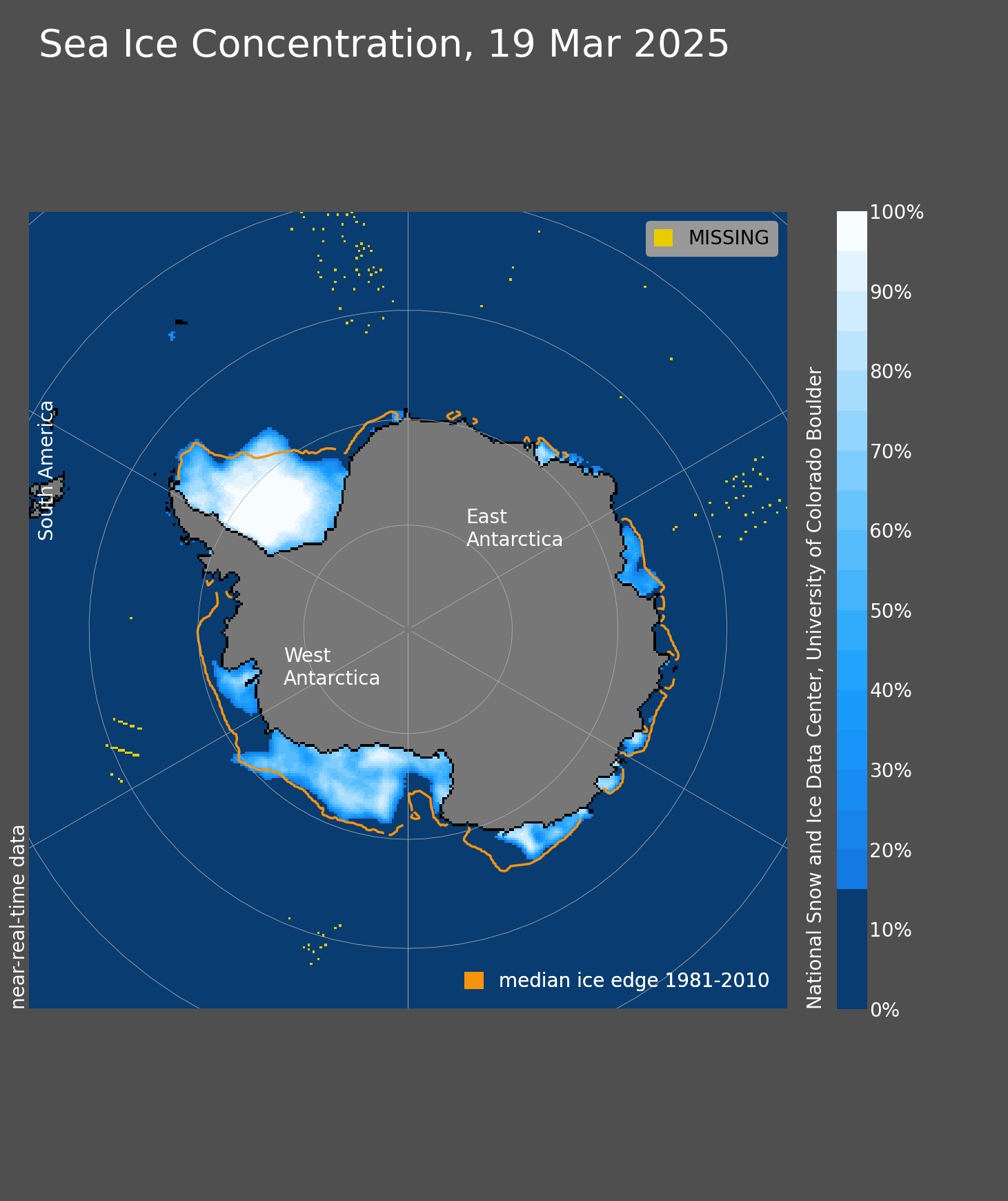








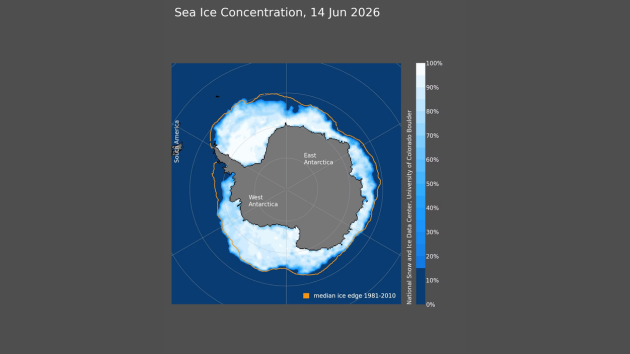
(ANTARCTICA) — A massive chunk of sea ice in West Antarctica has not refrozen following a winter heatwave in the region – a dramatic change that could further contribute to global sea level rise, experts told ABC News.
Graphics based on satellite imagery from the University of Colorado Boulder’s National Snow and Ice Data Center taken on Sunday show a large portion of sea ice measuring approximately 150,000 square miles – roughly the size of Montana – is not included in what is typically already frozen at this time of year, which is mid-winter in the Southern Hemisphere, experts told ABC News.
Every winter, Antarctic sea ice grows and decays, Peter Neff, a glaciologist at the University of Minnesota who specializes in ice core records, told ABC News. But since 2015, Antarctic sea ice has entered a “new, much reduced state,” in which less and less is re-freezing due to rising air and sea temperatures, Neff said.
This year, the level of sea ice in West Antarctica is about 50% lower than average, Neff estimated.
“This is a dramatic but not surprising observation in the context of the huge changes that have been occurring in Antarctica, particularly in this region of Antarctica, over the past decade,” Chuck Amsler, a professor of biology at the University of Alabama at Birmingham, told ABC News.
If the West Antarctica Ice Sheet were to collapse in its entirety, it has the potential to contribute more than 10 feet in sea level rise, according to a 2025 study by the International Thwaites Glacier Collaboration, a partnership between U.S. and U.K. agencies.
It is possible that this year’s June sea ice level in the area may surpass last year’s record low, Rose Malanga, a Ph.D. student at the University of Illinois Urbana-Champaign who conducted field research in Antarctica earlier this year, told ABC News. In June of both this year and 2025, the region had some of the lowest sea ice levels on record, Ellen Buckley, an assistant professor at the University of Illinois Urbana-Champaign’s Department of Earth Science and Environmental Change, told ABC News.
Data gathered by the Copernicus Earth observation program in June 2025 showed there was 12.6 million square kilometers of Antarctic sea ice, which is about 1.3 million square kilometers less than the 1991-2020 average.
Contributing factors likely include strengthening westerly winds, a phenomenon that’s connected to global warming due to climate change, as well as how the ocean is responding to those surface winds, Neff added.
A low-pressure anomaly north of the Bellingshausen Sea, which is adjacent to West Antarctica’s Antarctic Peninsula, is likely causing warm air from higher latitudes to warm the region and prevent sea ice formation, Buckley said.
“Winds drive how the ocean moves, but satellites can’t see into the ocean, so without being able to get down there, especially during the wintertime, we have very limited ability to do research,” he said.
The news of the lack of sea ice comes on the heels of above-average temperatures in the region, records show.
From January through April, the Bellingshausen Sea, where the ice would typically form, has seen sea surface temperatures anywhere from 1.8 to 5.4 degrees Fahrenheit above average, according to National Oceanic and Atmospheric Administration data. Throughout May, the sea surface conditions cooled slightly but remained about 1.8 to 3.6 degrees Fahrenheit above average temperatures.
In June, the Bellingshausen Sea surface temperature varied by as much as 1.8 degrees Fahrenheit above normal. Air temperatures over the Bellingshausen Sea are forecast to be up to 18 degrees Fahrenheit above average from Tuesday through the weekend.
The area that has not yet refrozen is located upwind of the regions on the Antarctic Peninsula that just experienced this warming. The heat wave can contribute to the lack of sea ice extent because there is not reflective white ice surface to keep it cold, Neff said.
“With this kind of situation where there isn’t sea ice forming in the winter, that means in the spring there will be less sea ice to melt,” according to Buckley.
The question of why the Antarctic sea ice freeze and thaw cycle has been behaving differently in the last 10 years, compared to the previous 30 years, is a “huge area of research” right now, Neff said, especially in the western region of the continent, which is being monitored closely by scientists.
Glaciologists have taken a particular interest in Antarctica’s western shelf due to its potential to cause a severe rise in sea levels. Thwaites Glacier, also known as the “Doomsday Glacier,” already contributes to 4% of overall sea level rise, while Pine Island Glacier is one of Antarctica’s fastest-melting glaciers.
Deterioration of the remaining portion of the Thwaites Glacier’s floating ice shelf has been accelerating in recent months and is likely to break off in the coming weeks or months, Neff said, adding that while it won’t completely destabilize the glacier it will contribute significantly to global sea level rise.
The Antarctic Peninsula is warming about five times faster than the global average. The most severe heat event occurred in March 2022, when the continent recorded temperatures between 54 degrees and 72 degrees Fahrenheit above normal.
“The warm events are expected to be coming more frequently,” Neff said.
ABC News’ Kenton Gewecke and Sam Wnek contributed to this report.
Copyright © 2026, ABC Audio. All rights reserved.