








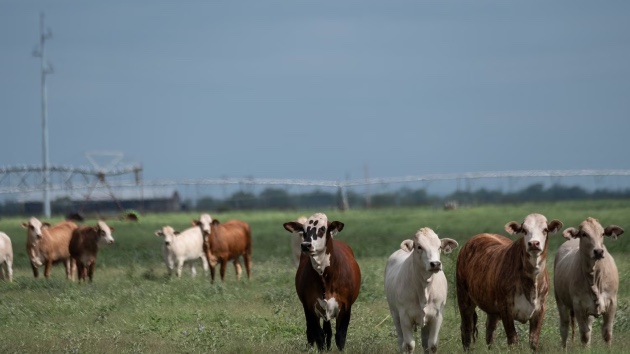
(NEW YORK) — The detection of New World screwworm in cattle does not pose a risk to beef consumers, and humans are unlikely to become infected by the parasite themselves, experts told ABC News.
There have been a total of six cases of New World screwworm (NWS) detected among animals in the U.S. since the beginning of the month — in four cattle, one goat and a dog, according to the latest update from the U.S. Department of Agriculture.
The goat was newly confirmed as the latest case to be infested with New World screwworm, Secretary of Agriculture Brooke Rollins said in a press conference Monday.
The screwworm likely migrated from Mexico and Central America, Ben Weinheimer, president and CEO of the Texas Cattle Feeders Association, told ABC News. The U.S. closed the border to Mexican cattle coming into the country in 2024 as a result of the screwworm outbreak in the region, Derrell Peele, a livestock marketing specialist at Oklahoma State University, told ABC News.
Officials continue to investigate the case of the dog that they believe likely may have been infected in Mexico, Rollins said. The screwworm typically spreads by transport of either livestock or pets, Peele said.
The screwworm does not currently present a food safety issue, Rollins said, adding that there is “no need to panic.” A screwworm infection does not affect the meat, Peele said.
“These developments obviously represent a serious threat to our livestock and wildlife, but they haven’t caught us off guard,” Rollins said. “We have been tracking this pest for a long time, and we have fought before, and we will do so again.”
Americans can continue to feel confident about consuming beef safely, Dustin Pendell, a professor of agricultural economics at Kansas State University and director of the Collaborating Center for the Economics of Animal Health, told ABC News.
The outbreak marks the first time the screwworm has been detected in the U.S. in decades. The USDA officially declared the screwworm eradicated from the U.S. in 1966 and successfully eliminated a small outbreak in the Florida Keys in 2017, which occurred primarily among endangered Key deer.
Screwworms infestations begin when a female fly lays eggs on open wounds or other parts of the body in live-warm-blooded animals, according to the Centers for Disease Control and Prevention.
The screwworm is “very treatable” if caught early, which allows the animals to be minimally impacted, Weinheimer said.
The USDA uses the sterile insect technique to treat for screwworm. The highly effective treatment involves sterilizing screwworm pupae — the immobile stage of the screwworm before metamorphosis — by exposing them to gamma radiation and then releasing them into the wild to mate with fertile females. The females then lay unfertilized eggs that never hatch, ending the reproductive cycle.
Millions of sterile flies have already been released in the affected area, USDA officials said.
State officials also apply containment protocols, including establishing quarantine zones, in order to contain infestations, Weinheimer said.
“You’ve seen this huge surge in response by the federal and state officials to stay on top of it as much as possible,” Weinheimer said.
Construction of a new sterile fly production facility is underway at Moore Air Base in Texas and is expected to be completed by November 2027, Rollins said. Once completed, along with other facilities, an estimated 500 million sterile flies will be released on a weekly basis.
Screwworms are actually a fly larva that burrows into and eats living flesh, unlike regular maggots that only feed on dead and decaying matter, according to the CDC.
Symptoms in animals could include a wound that has not healed or a wound that smells foul, Ann Hohenhaus, senior veterinarian and director of pet health information at Schwarzman Animal Medical Center, told ABC News last week. White larva may also be visible within the skin lesions, Hohenhaus said.
Infected cattle may not feel well and may stop producing milk and gaining weight, Hohenhaus said. The parasite can also infect a herd quickly if treatment does not begin early enough, she added.
Infection in humans is not common, Hohenhaus said.
People who have open wounds or small breaks in the skin — such as a scratch, insect bite or recent surgery scar — could be at increased risk of screwworm infection if they are in areas where the flies are present, according to the CDC.
Those who have open or unhealed wounds should see a physician should they believe they were exposed to the parasite, Hohenhaus said.
The outbreak is not expected to cause beef prices — which are already at an all-time high — to increase, the experts said.
The current drought conditions in the U.S. is making it difficult to expand herds because there isn’t enough grass available to feed on, Pendell said, adding that hay and other supplemental feeds increase costs even more.
In addition, geopolitical issues, such as the war in Iran, are causing fertilizer and fuel costs to increase, William Secor, a livestock economist at the University of Georgia, told ABC News.
“Cattle prices are going to continue to be high for quite a while because of these issues,” Pendell said.
However, the costs from the screwworm will be absorbed by producers, and consumers will likely not see any further price increases from the outbreak alone, Secor said.
ABC News’ Youri Benadjaoud contributed to this report.
Copyright © 2026, ABC Audio. All rights reserved.


